Adana TechnologiesLABS
AI GOVERNANCELive demo

GovernanceReady

Engage an AI Governance Engineer for your agency

GovernanceReady puts an AI governance engineer on your agency's AI program. It pulls together the records you already keep, finds what is wrong, recommends which uses are high-impact, drafts the assessments and the governance plan, runs the lifecycle gates and monitoring, and prepares your OMB submissions, with every answer traced to the record or evidence behind it.

Synthetic agency. No real agency data. Not legal advice.
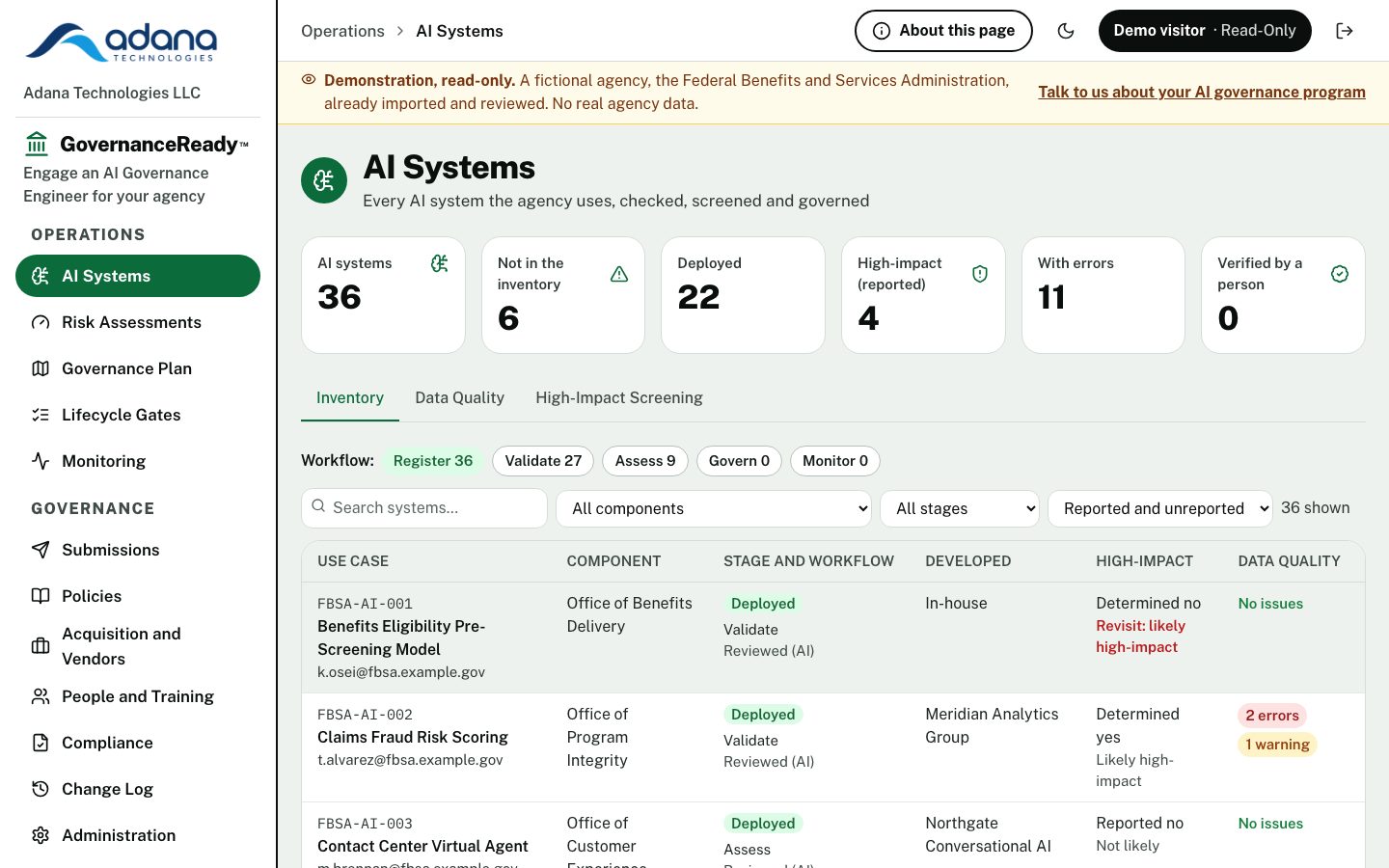
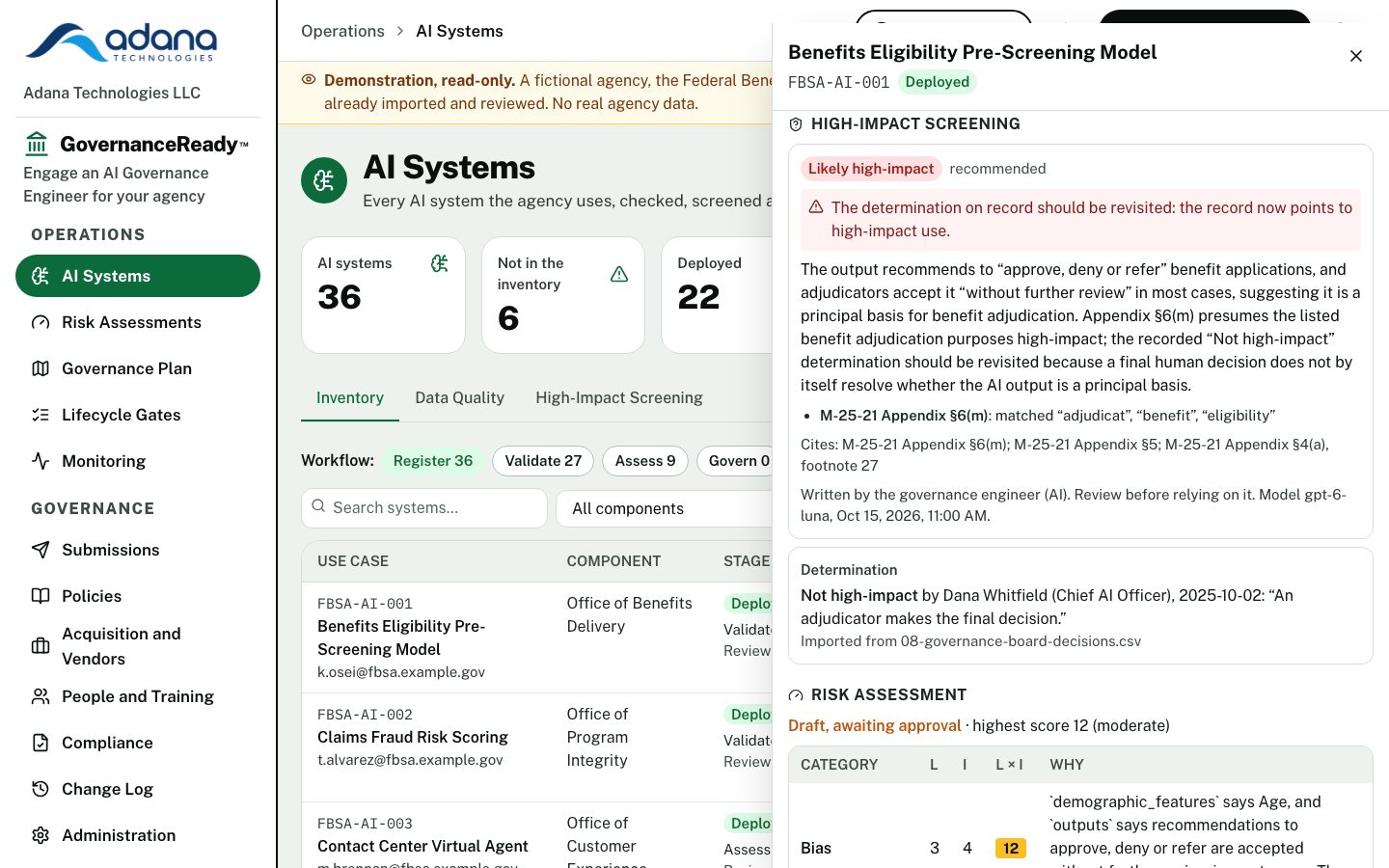
GovernanceReady AI Systems page for a fictional agency: 36 systems, 6 not in the inventory, with each system's stage, workflow step, high-impact status and data quality

THE PROBLEM

The records exist. Turning them into a submission you can defend is the work.

OMB M-25-21 and M-25-22 set what agencies must do for the AI they use and buy: an annual use case inventory, minimum risk management practices for high-impact AI, and new contract terms. M-26-04 adds terms for the large language models agencies buy.

The facts sit in an inventory spreadsheet, an application register, the FISMA system list, contracts, board minutes, training records and policies, and they rarely agree.

Someone who knows the policy still has to reconcile them, find the uses that are high-impact, write the assessments and plans, and show the evidence behind every answer before the Chief AI Officer signs.

HOW IT WORKS

One workflow for every AI system, with an engineer at each step

  1. 01

    Register and validate

    Import the records you already keep, in thirteen common layouts. The engineer reconciles them, finds AI missing from the inventory, duplicates and answers the records contradict, and says how to fix each one.

  2. 02

    Assess and govern

    It screens each system against the high-impact purposes in M-25-21, drafts risk and impact assessments, builds the governance plan and runs seven lifecycle gates. Your Chief AI Officer and Board decide, and each decision is recorded with the name of the person who made it.

  3. 03

    Monitor and submit

    It reads monitoring indicators against their thresholds and opens reassessments, checks contracts and policies, and prepares each OMB submission with what still blocks it and the evidence behind every answer.

INSIDE THE PILOT

What you see in the demo

01

High-impact uses found, with the section they rest on

The engineer screens each system against the high-impact purposes in M-25-21 and cites the section behind its recommendation. A person decides, and the determination is recorded with their name.

System panel for a fictional benefits eligibility model, screened as likely high-impact with the M-25-21 sections it matches and a flag that the determination on record should be revisited

02

Contracts checked against the clauses OMB expects

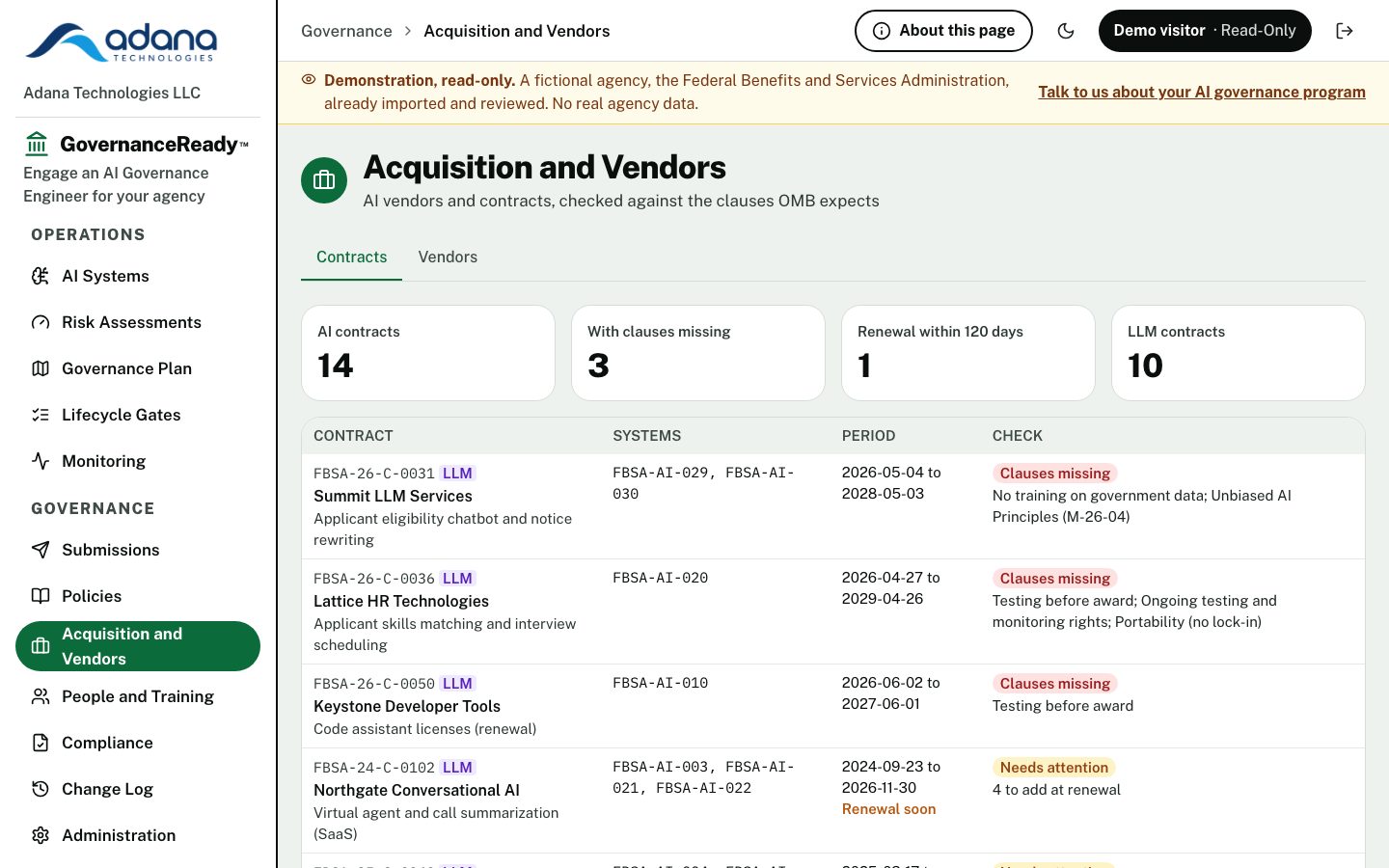
Each AI contract is checked against the M-25-22 and M-26-04 clauses: missing now, due at renewal, or in place. The engineer drafts the evidence request to the vendor.

Acquisition page listing a fictional agency's AI contracts, with the clauses each one is missing

03

Questions answered with the section they rest on

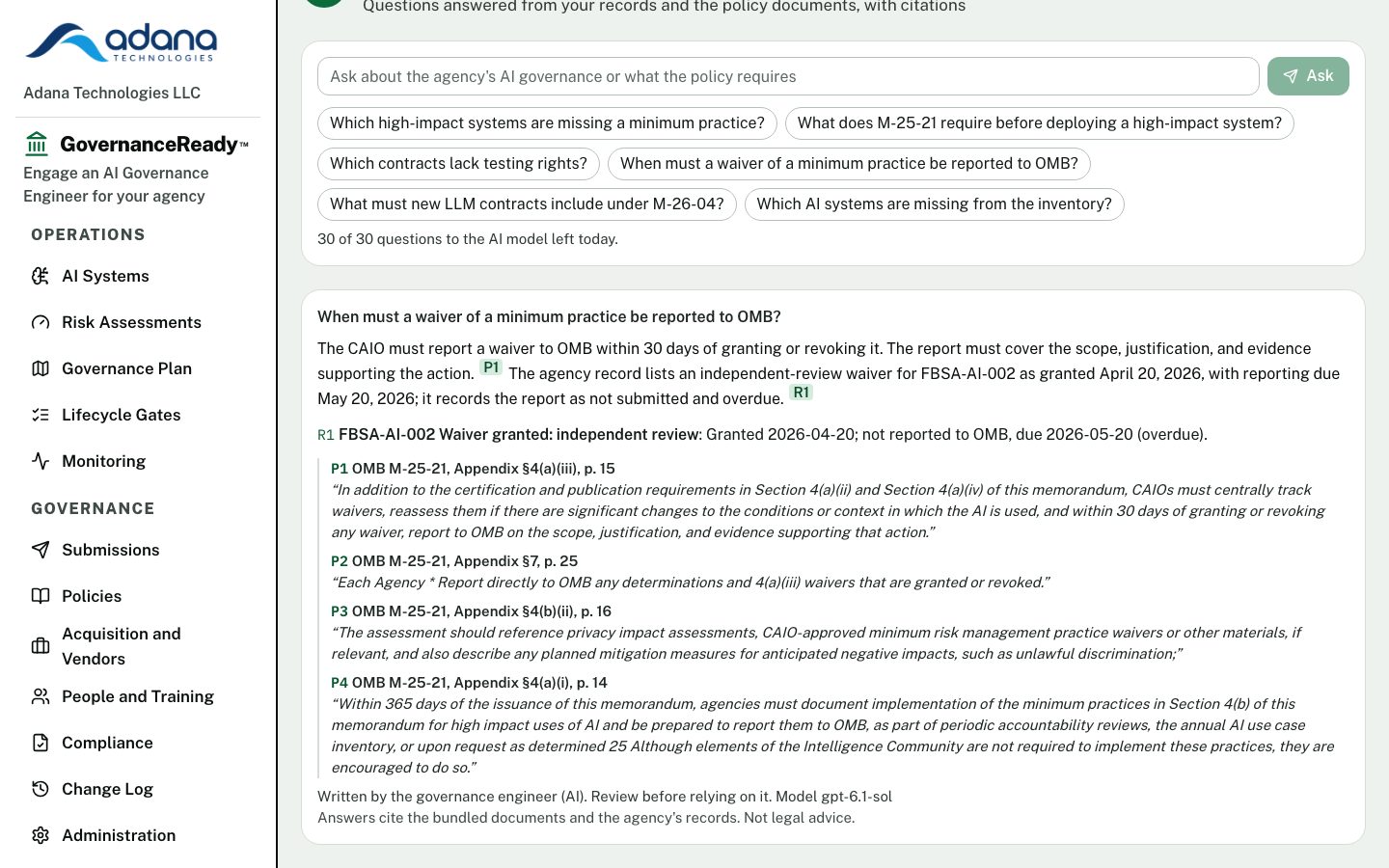
Ask about your records or about the policy. Each answer cites the document and section, lists the agency's records it used, and says so when the documents do not answer.

Ask GovernanceReady answering when a waiver of a minimum practice must be reported to OMB, citing M-25-21 and the agency's own overdue waiver record

04

Every OMB submission, with what still blocks it

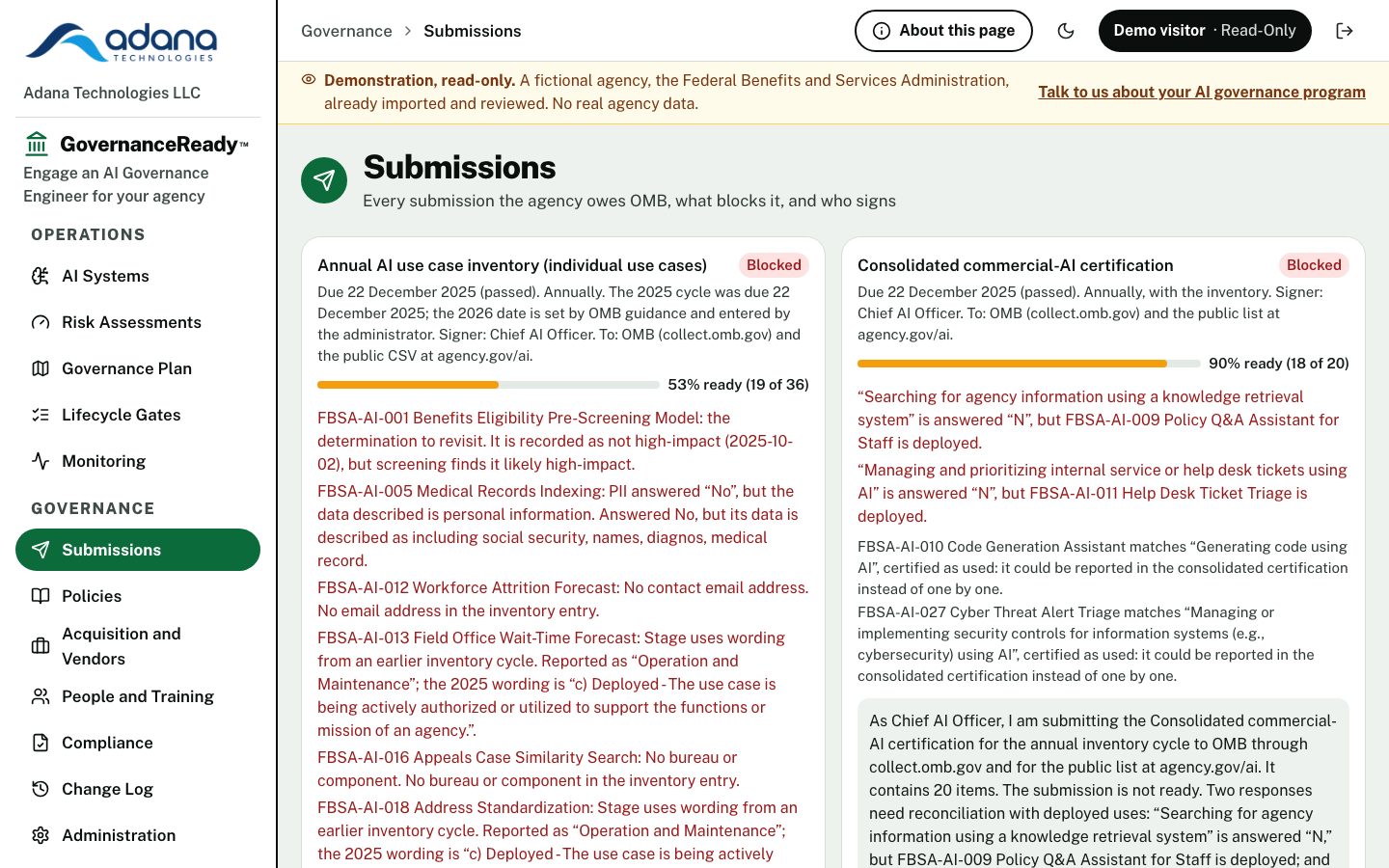
The eight submissions the agency owes, how ready each one is and the records that block it. The engineer prepares the draft; only the Chief AI Officer signs, and the signed version is frozen with its hash.

Submissions page for a fictional agency showing the annual AI use case inventory and the commercial-AI certification, each with its readiness and blockers

WHO IT IS FOR

Built for the people who answer for the agency's AI

Chief AI Officers and governance boards

Determinations, gate approvals and submissions you can defend, each traced to its evidence.

System owners and privacy officers

What each system still needs before its next gate, and its assessments drafted from its own records.

Acquisition staff

Contracts checked against the clauses OMB expects, and vendor evidence requests ready to send.

UNDER THE HOOD

Production-grade, even as a pilot

  • Isolated container on AWS. Runs on its own, behind a shared load balancer.
  • HTTPS only. Every connection is encrypted with a managed certificate.
  • Secrets in a vault. Keys live in AWS Secrets Manager, never in code.
  • Read-only demonstration. Visitors see a fictional agency already worked through; nothing they do changes it.

QUESTIONS

Before you ask

Is the governance engineer a person?

No. It is an AI model that does the work a governance engineer would do at each step, and everything it writes says so. It recommends; a named person decides. If the model cannot be reached, built-in rules do the same work and the screen says which wrote it.

Does the demo use real data?

No. The demonstration is a fictional agency, the Federal Benefits and Services Administration, with invented systems, people and contracts.

How do I get into the live demo?

Open the live demo and choose "Explore the demonstration". No password is needed, and the account is read-only.

Which policies does it follow?

Current federal civilian policy: OMB M-25-21, M-25-22 and M-26-04 and the OMB 2025 inventory guidance, with the NIST AI RMF and GAO's AI Accountability Framework as practice. Rescinded memos appear only as history. It is not legal advice.

Is this a finished product?

It is a working pilot: a real application you can use, scoped to show the approach. A full engagement adapts it to your agency's records, systems and reporting.

Put a governance engineer on your AI program

A 30-minute walkthrough on the fictional agency, with the questions that matter to yours.