Adana TechnologiesLABS
CYBERLive demo

ATOReady: Engage an Authorization Engineer for your systems

ATOReady puts an authorization engineer on your agency's systems. It imports the authorization records and security data you already keep, walks every system through the seven steps of the Risk Management Framework, keeps each control's evidence current, runs every POA&M against the BOD 26-04 clocks, watches the triggers your Authorizing Official agreed to, and briefs the AO with insights traced to the records behind them.

Synthetic agency. No real agency data. Not legal advice.
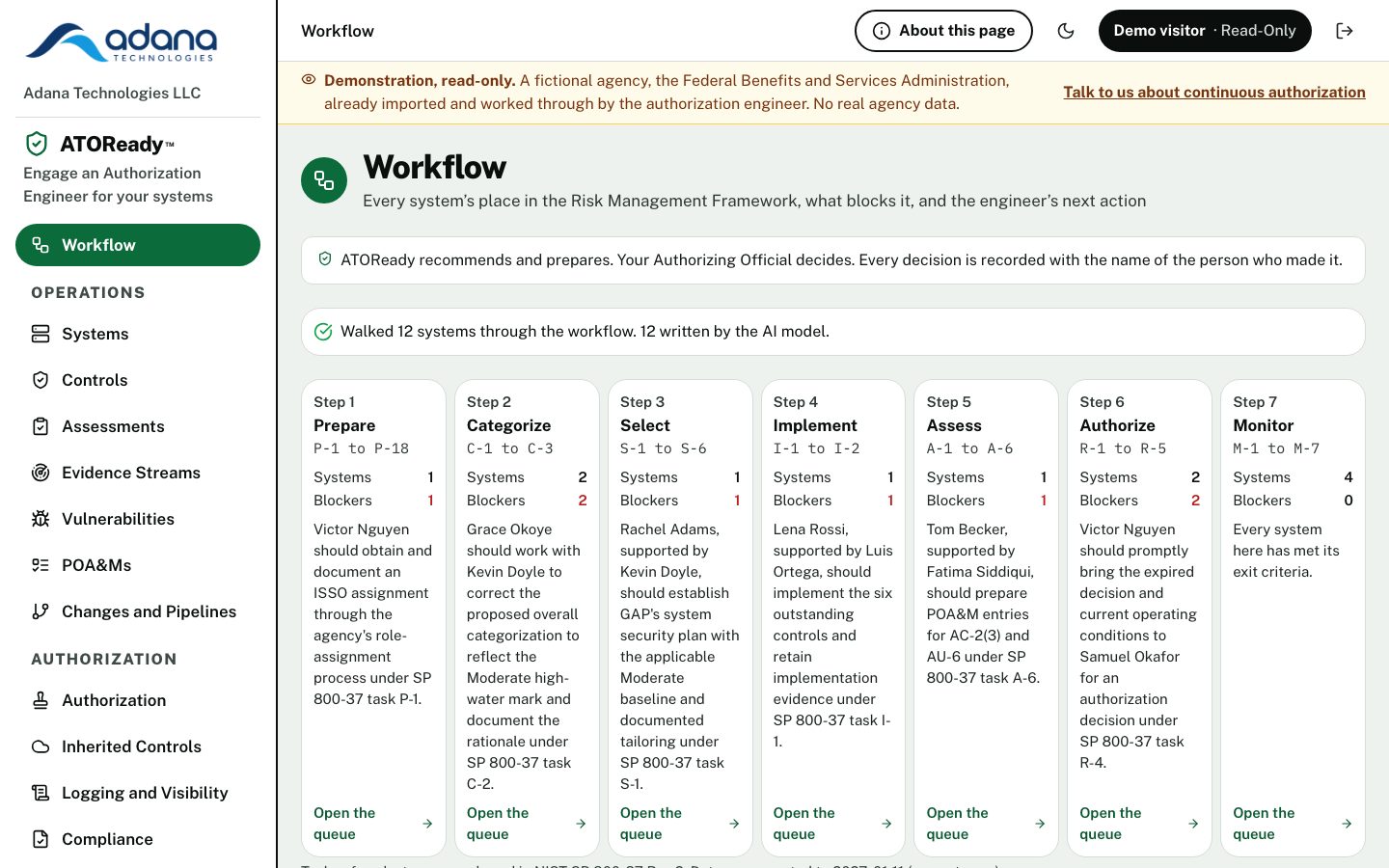
ATOReady Workflow page for a fictional agency: the seven RMF steps with the systems at each, the triggers raised and the BOD 26-04 clocks

THE PROBLEM

Stay authorized every day, not every three years.

An authorization is meant to stay current between decisions. NIST SP 800-37 calls this ongoing authorization, and it rests on continuous monitoring: evidence that each control still works, and a POA&M that tracks every weakness to closure.

From 7 December 2026, CISA BOD 26-04 gives each vulnerability a deadline of 3, 14 or 60 days from a decision table, and OMB M-26-14 sets the logging maturity each system must reach and by when.

The records sit in SSPs, scan exports, POA&M spreadsheets, pipeline results and past decision letters, and they rarely agree. Someone still has to reconcile them, find what has slipped and tell the Authorizing Official what needs a decision.

HOW IT WORKS

Seven RMF steps for every system, with an engineer at each one

  1. 01

    Import and place

    Import the records you already keep, in nineteen common layouts. The engineer finds what is wrong with them and places each system at its RMF step, with what blocks it and the SP 800-37 task behind it.

  2. 02

    Monitor and remediate

    Scans, configuration results, SBOMs, pipeline gates and logging self-assessments keep each control's health current. Every vulnerability gets its BOD 26-04 deadline, and every POA&M runs to closure with each slipped date kept.

  3. 03

    Brief and decide

    When a trigger the AO agreed to fires, such as a major incident, a significant change or overdue items, the engineer assembles the package and briefs the AO. Your Authorizing Official decides, and each decision is recorded with the name of the person who made it.

INSIDE THE PILOT

What you see in the demo

01

Every vulnerability on BOD 26-04's table, with its deadline

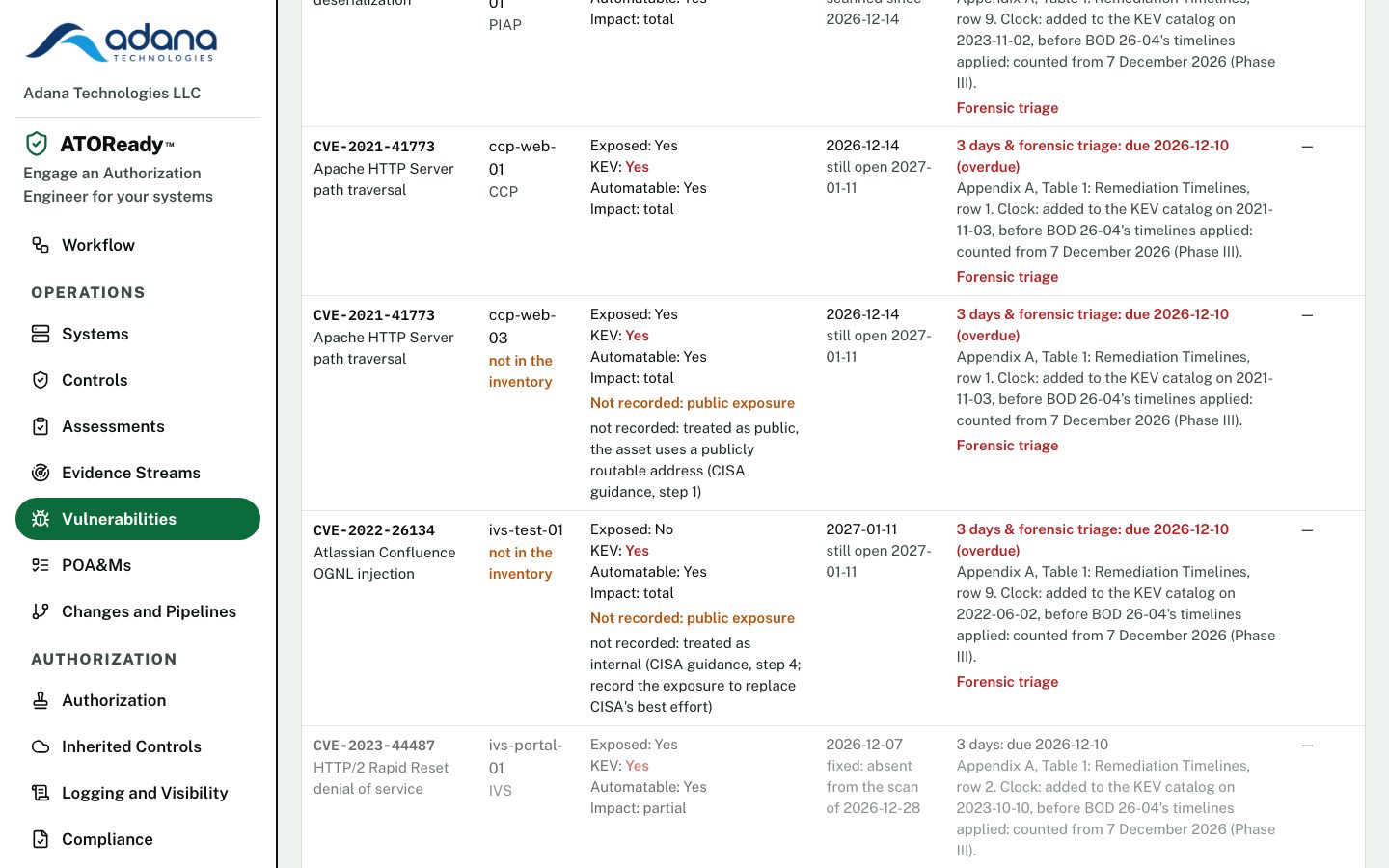
Each finding is placed on the directive's Table 1 from its exposure, KEV status, automatability and technical impact, with the row it rests on and its deadline. A factor that was missing is resolved by CISA's own rule and flagged.

Vulnerabilities page for a fictional agency, with each finding's BOD 26-04 placement, deadline and forensic-triage flag

02

Every POA&M from opening to closure, with every date it slipped

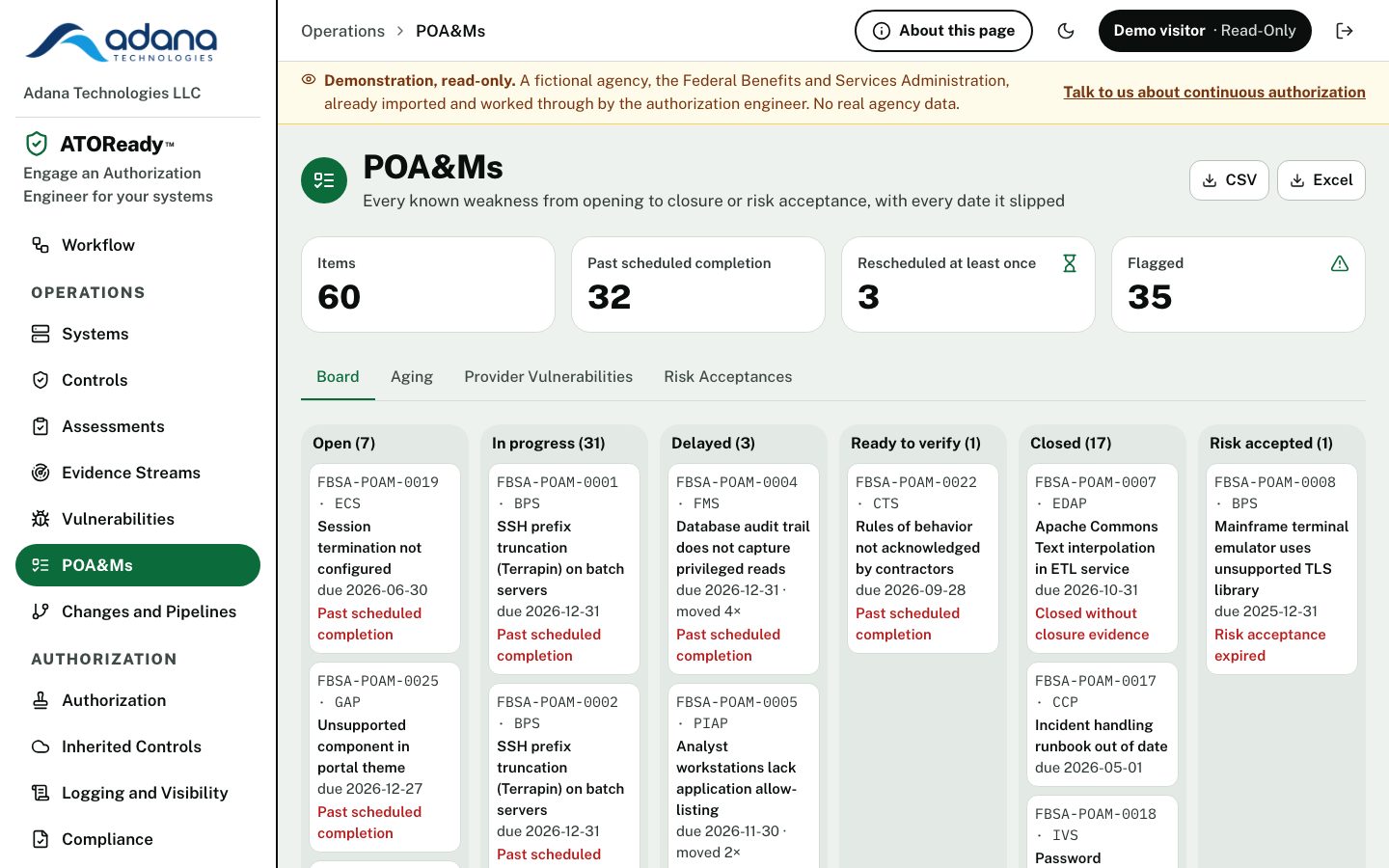
The board by state. An item closes only with closure evidence and a verification, a risk acceptance needs the AO by name and an expiry, and an item moved again and again is flagged as risk acceptance by delay.

POA&Ms board for a fictional agency, with items in Open, In progress, Delayed, Ready to verify, Closed and Risk accepted

03

Triggers the AO agreed to, briefed when they fire

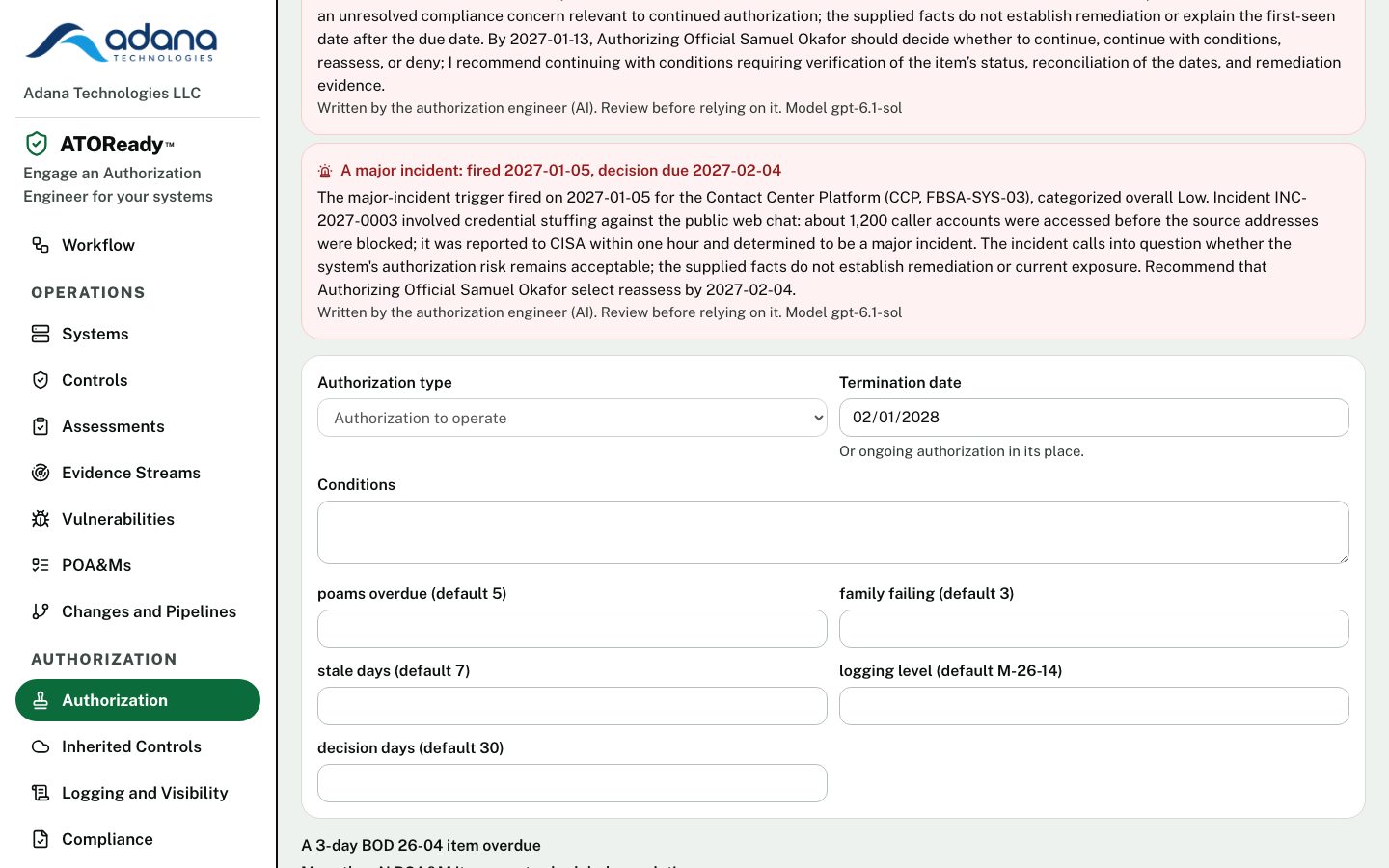
Each system's authorization terms: the decision type, its conditions and the triggers that call for a new decision. When one fires, the engineer briefs the AO; the decision is the AO's alone, frozen as a version with its hash.

Authorization page for a fictional agency, showing one system's terms and its open triggers with the decision due for each

04

The AO's view, every number computed from the records

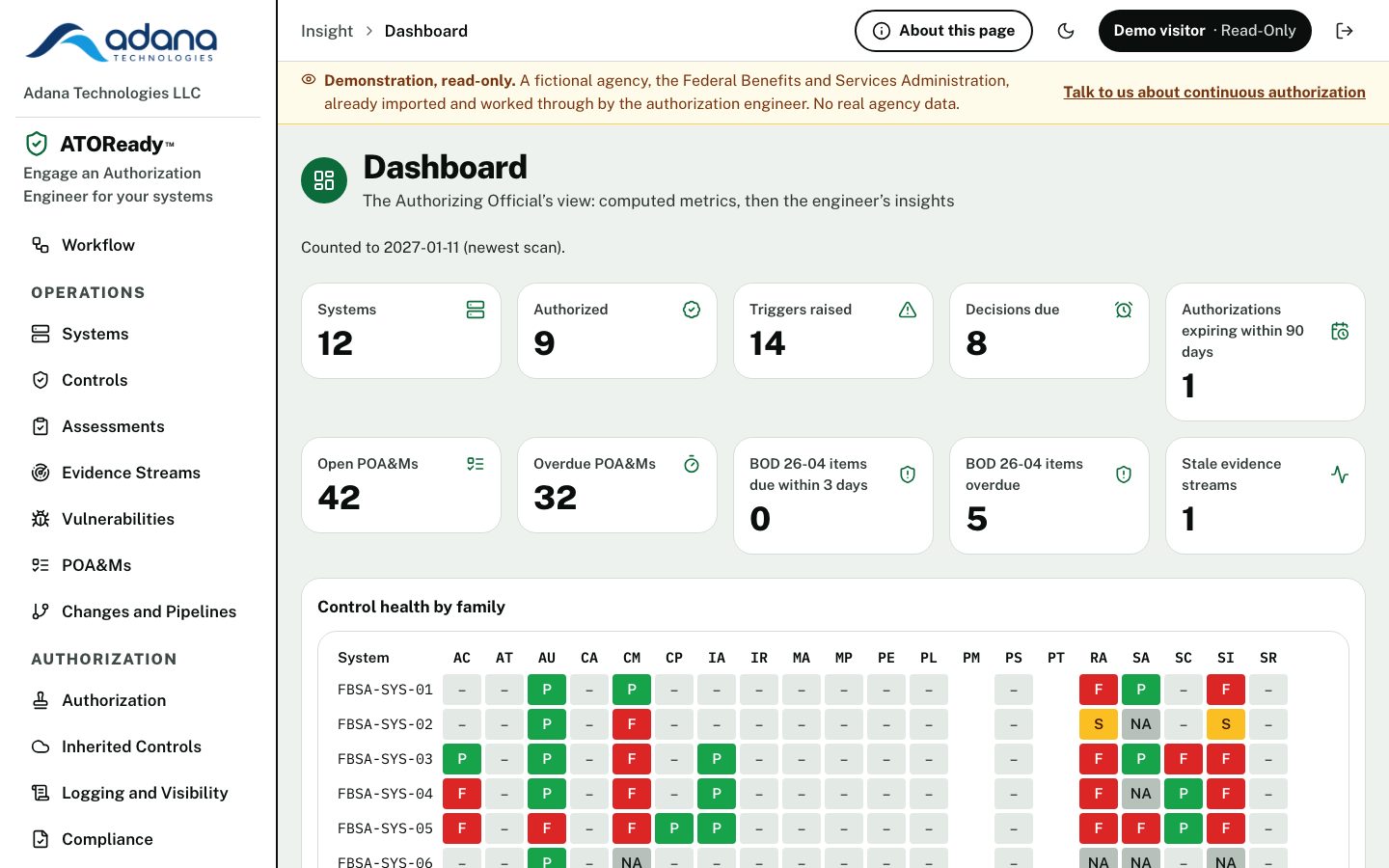
Ten stat cards and the control health heatmap, each computed by ATOReady from the records. Below them, the engineer's insights link to the records behind them, and one that states a number the records do not hold is refused.

Dashboard for a fictional agency: stat cards for systems, authorizations, triggers, POA&Ms and BOD 26-04 items, with the control health heatmap

WHO IT IS FOR

Built for the people who keep systems authorized

Authorizing Officials and their representatives

What needs a decision this week, the package behind it, and every decision recorded with a name.

CISOs, ISSMs and ISSOs

Each system's RMF step, blockers, evidence health and BOD 26-04 deadlines in one place.

System owners and DevSecOps teams

Which changes and releases stay within the authorization, and what to fix first.

UNDER THE HOOD

Production-grade, even as a pilot

  • Isolated container on AWS. Runs on its own, behind a shared load balancer.
  • HTTPS only. Every connection is encrypted with a managed certificate.
  • Secrets in a vault. Keys live in AWS Secrets Manager, never in code.
  • Read-only demonstration. Visitors see a fictional agency already worked through; nothing they do changes it.

QUESTIONS

Before you ask

Does ATOReady grant an ATO?

No. Your Authorizing Official decides. ATOReady recommends, prepares the package and monitors. A decision in any name but the system's AO of record is refused, and each decision is recorded with the name and role of the person who made it.

Is the authorization engineer a person?

No. It is an AI model that does the work an authorization engineer would do at each step, and everything it writes says so. If the model cannot be reached, built-in rules do the same work and the screen says which wrote it.

Does the demo use real data?

No. The demonstration is a fictional agency, the Federal Benefits and Services Administration, with invented systems, people, hosts and findings. The CVE IDs and CISA's KEV catalog are public.

How do I get into the live demo?

Open the live demo and choose "Explore the demonstration". No password is needed, and the account is read-only.

Which policies does it follow?

Current federal civilian policy: NIST SP 800-37 Rev 2, SP 800-53 Release 5.2.0 and SP 800-53B, CISA BOD 26-04, OMB M-26-14 and FedRAMP's 2026 rules for cloud services. Rescinded directives appear only as history. It is not legal advice.

Is this a finished product?

It is a working pilot: a real application you can use, scoped to show the approach. A full engagement adapts it to your agency's records, systems and reporting.

Put an authorization engineer on your systems

A 30-minute walkthrough on the fictional agency, with the questions that matter to yours.